Introduction
I served as the executive head of the Social Innovation Club of IIT Madras during my undergraduate studies. During this time I got to see what makes or breaks the rise (and fall) of student clubs (and arguably, early stage startups). I am writing this "Leading a Student-Run Club" series of articles to share what I have learnt through these. (This won't be another Linkedin slop, I promise!)
The best part about being a student leader in such a club is it requires you to wear multiple hats. We cannot cover everything in one blog post, hence I'll first cover content about gaining the team's faith and enabling consistent progress in this article. I'll write more about strategy, publicity and business relations in the subsequent ones. (I'll try my best to skip all the generic advice that are already too overpreached for what they're worth ;)
Part - I: Team Accountability
Most people when they hear the word "accountability" only associate it with "keeping the work done by the team members in check", but this is an incomplete idea of what it actually means in small collaborative teams. It is a charismatic balance - as we will see in subsequent headings.
Before that, let's clarify some definitions. In this article, your "peers" will be those who are at the same level as you in the team's hierarchy. Your "junior team" stands for the group that is working under your guidance/supervision.
1. How Do I Win My Peers?
The most difficult part of being a student leader is not keeping your junior team in check, but rather your own peers. The reason is simple, with your juniors, you will still feel like a "higher up" even if you are friendly and approachable. To your peers you're just another person as clueless as themselves.
1.1. Being Reliable
One of the things you should practice is being reliable as a friend and a human-being first. Might sound like a cliché tip, but consider this scenario: You are fighting with your life to get an internship for the coming summer, and this so-called "head" in an organization (that doesn't even pay you) wants you to make a poster for an event urgently. Do you even care?
Being reliable as a friend and a human-being first
There's no shame in saying "No". In fact, almost everyone leading student clubs will come across such a scenario, including myself. This is where you establish your reliability as a person. I cannot question anyone's priorities. But I can let them know that I respect their priorities, and that I will make up for them for as long as I can, in the hope that they come back to it. The most natural tendency of humans is to return favours. Consider this message below:
Hey, I hope me mentioning this is okay and not intrusive or anything. I just wanted to let you know that I am aware that you aren't able to be very active in the club because you're trying to get an internship currently. I'll try my best to make up for it by taking your share of work here for as long as I can.

Please do let me know once you have it sorted though. It'll be great to have you active again in the team and to see you take creative control here.

Also feel free to let me know connecting with anyone in my network might help you in your job search. I would be glad to do whatever I can
This is one example you could possibly write. Your peers most likely won't ask you for any help in this directly per se, but mentioning that they can contact you for any help even outside the club is a gesture. It tells them that more than just the club, you also are reliable as a human. Now fast-forward to several months ahead, I had to take a hiatus for reasons I could not disclose, but my peers did not bother asking me to explain why, they just made up for me like nothing ever happened. When the team knows that you care about your members, they'll care more about the club.
1.2. Show Up Prepared
Making the time your peers spend working with you feel productive is one way to respect their own time. Posting the agenda beforehand and showing up prepared is the only way to consistently do that. Other cliché ways to say this would be "lead-by-example" haha!
There is a psychological gravity that humans have towards working with confident (or even slightly overconfident) and knowledgeable people. Even if you don't feel very confident naturally (all of us have our own share of it!), you can always boost it by preparing beforehand. Whenever your team learns 3 things from you, that's when they'll accept you as their leader. It's worth mentioning that these "learnings" need not necessarily just be technical, it can also be things like speech writing, body language, etc.
Whenever your team learns 3 new things from you, that's when they'll accept you as their leader
Being professional matters the same amount too. In our club, we had a thumb-rule that we cannot impose any deadline, meeting or "urgent work" on anyone else if we are announcing it within 24 hours before time. For example, if someone has to schedule a meeting in the next 3 hours, then that would be considered an artefact of misplanning, and others won't be obliged to show up with that short a notice. (Ofcourse voluntarily working together on short notice was still encouraged)
2. How Do I Push My Junior Team Towards Our Goals?
The biggest difference between a student club and a company is monetary incentive. Well ofcourse, you have to tune the recruitment process with pre-decided interview questions, response sheets, etc to recruit only the folks who are truly passionate in your club's line of work. But no pipeline is perfect. So at the end of the day, you have to figure out how to motivate your team.
2.1. Externalization
This is not to be confused with the "externalization" that B-schools and supply chain folks refer to (which has to do with outsourcing, etc), but I still like to call it externalization: the process of making a deadline seem like it's imposed by someone who's outside the club. Consider the difference between these two announcements:
A: "Hey guys, to ensure consistent progress, we will have a review of your project on Monday, please make sure you have a good amount of stuff to show".

B: "Hey guys, on the 15th of this month, we have invited our alums and other professors who will help us with a round of reviews of our projects in an all-team  meet. Please plan ahead and put on a good show!"
Announcement A is most probably going to have your junior team thinking "Okay it's just an internal review. I can get away with the bare minimum, or I can even postpone it easily in the worst case". While announcement B makes it non-negotiable. More importantly, it seems like it's not even within the control of the club, and they have to put together a good pitch or a demo.
Make anything that needs to be imposed (such as deadlines) seem external.
In other words, make deadlines seem external. Make specifications/requirements from the team seem external. Make anything that needs to be imposed/taken serious seem external. Here are some examples:
- All Team Review Meetings: Inviting Seniors, Alumni, Professors, etc.
- Work-Logs to which collaborators/investors (supposedly) have read-access
- Demo Videos of Minimum Viable Products to be sent across to someone
- Announcement that the parent organization has made criterias for projects to be put up on investor summits / open days
2.2. Minimum Viable Product
Now that we've already mentioned this in the previous part - This is something I learnt during my Internship at Microsoft. My main goal was to demonstrate a graph traversal idea. I was stuck with trying to make C# hit Azure DevOps APIs. My manager told me to first hack my way out of it by just running a "git pull" process in the background, so that I can demonstrate my graph traversal idea as early as possible. He said that producing a "Minimum Viable Product" early is more important than addressing the small details that won't really change the demo visibly.
Tell your team to produce the minimum viable product that demonstrates your idea, and zoom past the details that won't visibly change the demo.
This is a powerful idea because it allows your team to "fail fast" and get early feedback from the user segment that might adopt your work early. This idea combined with the idea of externalizing is a strong motivator to get your team into the phase of actually building instead of wasting time theorizing. Unfortunately, too many technical clubs just get stuck with .PPTX files and flowcharts instead of getting to the actual demonstrations.
I did not know this when I was the club head, but I do have an anecdote from one of my successors: we had discussed that they will tell their team, "our seniors are asking for real demos like videos showing working hardware or a "run all" on jupyter notebooks by first of the month". This helped them externalize the deadline and also make the team skip the pitch decks and jump into hacking together quick solutions.
2.3. Avoiding Redundant Responsibilities and Vague Action Items
One more age-old idea worth mentioning: there is a fine balance between having backups and having redundancies. As a small organization, you need to have atleast two people who know about one thing, so that probability of both of them being unavailable at one point in time is low. But having two people who are responsible for one thing will make it hard for you to follow up on the tasks.
Two people knowing about one thing != Two people responsible for one thing
Moreover, avoid ill-defined / vague goals. For anyone who doesn't yet have the maturity to imagine the complete lifecycle of a project, working with vague goals without complete alignment is an absolute waste of time.
3. When Things Go South...
Nothing happens as per the textbook. "Theory can only take you so far". In such cases, as a student leader, your role is to offer psychological safety to your team first, before getting to the facts and figures. Let's go one case at a time:
3.1. Apologize, not with a Justification, but with a Course of Action
What happens when you make a mistake? More importantly, what happens when there was a miscommunication and some essential task was not done by your team? Most people think "I'm genuinely sorry" will make that cut. Unfortunately, the phrase is malformed in itself: if an adjective like "genuinely" has to substantiate how much you mean the apology, then your apology doesn't make the cut.
Unfortunately, far too many people who are heading some club end up either riding on their ego to never step down and apologize, or end up justifying their side of things after the apology thereby undoing the apology. Consider the following apology:
Hey guys, I'm sorry to let you know that our collaborator has backed out of the project. I sincerely apologize for this setback. You folks have put in sincere efforts into this project and we will make sure we recover from this soon.

Here is what exactly happened: I was waiting for us to have a clean frontend to send across to them. While doing so, I should have given them periodic updates that we are still working on it. I missed to do so, and meanwhile they assumed that we abandoned the project.

To gain their confidence back, here are the things we plan to do: We will make a work-log, and make it available to them to read. We will also re-approach them with a minimum viable product in a month from now. And in the future, we will make sure we give periodic updates to our collaborators instead of milestone-based updates.

Sorry for this shortcoming again, and this one is entirely on the communication gap from my end. But please be assured that I will make sure we get the right avenues to launch our product.
Now let's dissect this:
- Note that I am saying that I take full responsibility for what happened. Reality is, it is not entirely on me. I don't mean to justify myself here, but its worth mentioning. Firstly, we really did take longer to finish the first milestone than what we planned within our limited capacity. And more importantly, it is unprofessional on the collaborator's side to cut us off with no follow-ups / nudges. But sometimes, you have to bite the bullet and take it upon you, and be the bigger person - for the better. It helps to say "I'm the most well-informed animal in this particular exchange, and I could just take it upon myself and make it quick to move past"
- I am not justifying my actions. But I am trying to be transparent with what exactly happened. Justifying will undo my apology, while transparency reinitiates the team's faith.
- I am giving them a course of action, a reason to believe that they can still put their faith on me. Why should they believe I will fix this? Because I jumped right into "what-next" and have already devised a plan for it.
Supplement your apologies with a course of action to recover from / not repeat the mistake
This is not only for apologizing to your junior team, but also to any other partners too. In a scenario that your club misses to do something important and the impact is felt by your collaborator, you take the entire blame of the club on yourself. And give this said partner a course of action that you'll take to avoid this from repeating. (And don't try to read their mind!)
3.2. Credit in Public, Confront in Private
I have seen way too many teams crumble because their team lead just yells at someone in a group meeting. I can't stress upon this enough. I've had friends who were immensely passionate about their team when they joined but left the same team with a gruesome story of how that team is toxic, and that story propagates faster than anything else.
Teams crumble the moment their team lead decides to yell at someone in a group setting
It's important to understand the psychology of people (and we will come back to this same idea again when we talk about publicity in part 2 of the series): Everyone wants to be the protagonist of their own story. Hence, noone is going to tolerate it if a leader is actually a threat to their own self-respect and dignity.
Then how exactly will you confront someone who hasn't contributed much to the club? You don't know what is going on in their life, so give them the benefit of the doubt once or twice. Ask in text or mail if they have any particular reason they aren't active. Grant a break if they want one. Only if they repeatedly break their promises they made do you step into action. And action must still be human, and the rest of the team also deserves an explanation of what exactly happened, if this happens. Avoid writing satirical emails when doing this, (Yes, some clubs actually do this, and it damages their reputation more than they think).
Giving credit and announcing acknowledgements in organization-level meetings goes a long way. Again, everyone wants to feel like a hero/heroine in their own story. Particularly so if this is a meeting with other seniors / alumni / professors. This builds a great culture. They say "you can tell if a workplace is toxic by just seeing if you get a 'good morning' from the security guard in the morning". This is simply because he/she would've cultivated this habit only if the other employees had been kind enough to wish them in the first place.
4. Misc: Cr*p Sandwich, Timing your Feedbacks, Nurturing the Sincere Ones
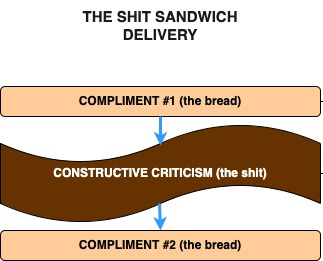
How feedback is given matters, and how it's timed matters. Follow the cr*p sandwich shown below. Time your feedback: calling out a mistake in a presentation just 5 minutes after it was executed is demoralizing and kills your team's spirit. In contrast, bringing it up in the project meeting 3-4 days later is constructive.
Moreover, there will always be this subset of folks who are being very sincere and proactive. It is your duty to identify these torchbearers. And more importantly, make sure they are never getting an unfair share of responsibilities. You'd never want to make someone feel that they are getting more and more work only because they are getting it done faster. It is your responsibility to treat them like your own mentees and do your job of delegating work right!
There are many more things to say here (that not just leaders but any human should consider): never interrupting anyone before they are done speaking, never keeping the phone on the desk in meetings, etc... There is no way any single blog post can be comprehensive on these, but luckily you can make your social media feeds bring these ideas to you time to time by subscribing to such content! For example, Simon Sinek has some brilliant videos which you might want to consider watching.
Final Note - Credit Where it's Due
I wouldn't have been able to learn all of this without the rest of my team being immensely cooperative during my time in the club, and also all my juniors who continued to keep in touch. "Legacy is like planting seeds in a garden you'll never get to see" - Lin Manuel Miranda. I want to be very clear that by writing this article, I am not trying to say I was the best the club ever had. In fact, the upcoming teams only got better and better! It's great to see them file patents and produce more IPs every year. If you found this article useful, do share it further! (and give Sahaay a follow)